Thursday, 27 November 2014


The Fourth Plinth is a plinth in Trafalgar Square in central London. It was originally intended to hold an equestrian statue of William IV, but remained bare due to insufficient funds. For over 150 years the fate of the plinth was debated; in 1999, a sequence of three contemporary artworks to be displayed on the plinth were announced. The success of this initiative led to a commission being formed to decide on a use for the plinth. Eventually that commission unanimously decided to continue using it for the temporary display of artworks.
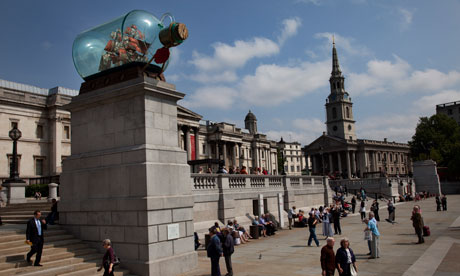
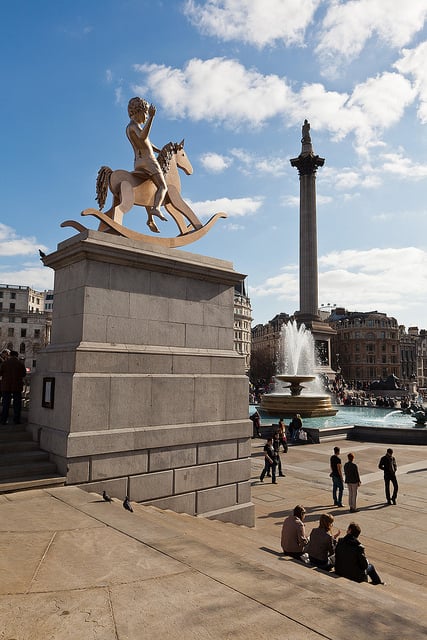


There is a plinth at each of the four corners of the square. The two southern plinths carry sculptures of Henry Havelock andCharles James Napier. The northern plinths are larger than those as they were designed to have equestrian statues, and indeed the northeastern plinth has one of George IV. The fourth plinth on the northwest corner, designed by Sir Charles Barry and built in 1841, was intended to hold an equestrian statue of William IV, but remained empty due to insufficient funds.


Monday, 24 November 2014

Oswaldo Guayasamin


Oswaldo Guayasamin was born on July 6, 1919, in Ecuador, the son of an indigenous Quechua Indian father and mestizo (mixed race) mother. He was the oldest of ten children, and early on developed a talent for art. His father was a hard working man who was distant with his son, often physically abusive, and consequently their relationship was never a close one. On the other hand, Oswaldo loved his mother dearly, and credited her with fostering his love of the arts and supporting him in the early stages of his career.


the name of the art work is called "Of Rage and Redemption".


this painting is guayasamin's last ever painting before he died in 1999. he is trying to show people a story about his life and also about how he was raised by indigenous people. in this piece art work i can see a person kneeling down the floor because he might be in pain emotionally, i can also see that this person is shouting for mercy and shouting because he is might be frustrated because he is trapped in something that's really impossible to escape for example he could be in a crisis or suffering with family issues. 

Guayasamín won the first prize at the Ecuadorian Salón Nacional de Acuarelistas y Dibujantes in 1948. He also won the first prize at the Third Hispano-American Biennial of Art in Barcelona, Spain, in 1955. In 1957, at the Fourth Biennial of São Paulo, he was named the best South American painter.
In 1988, he painted a very controversial mural depicting the history of Ecuador. The Congress of Ecuador asked him to do so. However, the United States Government criticized him because one of the paintings showed a man in a Nazi helmet with the lettering "CIA" on it.
Guayasamín dedicated his life to painting, sculpting, collecting; however, he was an ardent supporter of the communist Cuban Revolution in general and Fidel Castro in particular. He was given a prize for "an entire life of work for peace" by the United Nations Educational, Scientific and Cultural Organization. 

this video will show guayasamin's most famous and best paintings.   


Thursday, 6 November 2014

Leonardo da Vinci 


Leonardo da Vinci was born on 15 April 1452 near the Tuscan town of Vinci, the illegitimate son of a local lawyer. He was apprenticed to the sculptor and painter Andrea del Verrocchio in Florence and in 1478 became an independent master. In about 1483, he moved to Milan to work for the ruling Sforza family as an engineer, sculptor, painter and architect.


the name of the art work is called the Mona Lisa.

A very famous  painting of a woman which is known as  " the best known, the most visited and the parodied work of art in the world. What I think about this painting is that he is trying to use a lot of perfection in this piece of art.  what I men is that he tries to make the painting look like she was calm, relaxed and happy and the background he included is really interesting.

I can see mountains and the very old roads it looks like as if she was happy, relaxed and happy.
Really deep inside her she is probably stressed, upset because maybe she was poor, where she grew up was a really poor area or probably she grew up where there was war going on in her village or country.

what the  artist used on his art work was oil painting on poplar wood. he used a couple of techniques called ' sfumato' and 'velature'. Sfumato is an Italian word translated ' evaporated ' or 'vanished'. this type of technique involves light and dark paint, using tiny brush strokes, to create a blurry blending between two of the colours.

Velature is when an artist mixes different pain colours on canvas, instead of doing it on a pallet. Leonardo perfected both these techniques, as well as having general knowledge of the human anatomy and the laws of nature to make his paintings more realistic.