Thursday, 25 June 2015

Bauhaus


The Bauhaus was first founded by Walter Gropius in Weimar. In spite of its name, and the fact that its founder was an architect, the Bauhaus during the first years of its existence did not have an architecture department. Nonetheless, it was founded with the idea of creating a "total" work of art in which all arts, including architecture, would eventually be brought together. The Bauhaus style later became one of the most influential currents in modern design, Modernist architecture and art, design and architectural education. The Bauhaus had a profound influence upon subsequent developments in art, architecture, graphic design, interior design, industrial design, and typography

The school existed in three German cities: Weimar from 1919 to 1925,Dessau from 1925 to 1932 and Berlin from 1932 to 1933, under three different architect-directors: Walter Gropius from 1919 to 1928, Hannes Meyer from 1928 to 1930 and Ludwig Mies van der Rohe from 1930 until 1933, when the school was closed by its own leadership under pressure from the Nazi-led government which had claimed that it was a centre of communist intellectualism.Though the school was closed, the staff continued to spread its idealistic precepts as they left Germany and emigrated all over the world.

However, the most important influence on Bauhaus was modernism, a cultural movement whose origins lay as far back as the 1880s, and which had already made its presence felt in Germany before the World War, despite the prevailing conservatism. The design innovations commonly associated with Gropius and the Bauhaus—the radically simplified forms, the rationality and functionality, and the idea that mass-production was reconcilable with the individual artistic spirit—were already partly developed in Germany before the Bauhaus was founded. The German national designers' organization Deutscher Werkbund was formed in 1907 by Hermann Muthesius to harness the new potentials of mass production, with a mind towards preserving Germany's economic competitiveness with England. In its first seven years, the Werkbund came to be regarded as the authoritative body on questions of design in Germany, and was copied in other countries. Many fundamental questions of craftsmanship versus mass production, the relationship of usefulness and beauty, the practical purpose of formal beauty in a commonplace object, and whether or not a single proper form could exist, were argued out among its 1,870 members (by 1914)
















Thursday, 18 June 2015

Josef Albers was a German-born American artist and educator whose work, both in Europe and in the United States, formed the basis of some of the most influential and far-reaching art education programs of the twentieth century.


Communist posters

I have been looking at communist posters for example this type of poster. I like this poster because it helps me a lot on how can I make my sculpture look strong and firm. As you can see in this poster that they are holding a red book with their arms up high, you can see how strong the arms look, proud to be a revolutionary community. Also what I see in this poster is that these two men look like there workers that haven’t had a good salary wage. So they are happy that the revolution has begun after all those years of suffering they can do something about it now.  The arms they look strong and firm but also the hands are like they are holding the book tight, is like they were feeling passionate for the book they’re holding.


So this poster helped me a lot when I was making my sculpture. As you can see from the poster there arms are strong and firm as I mentioned in the beginning, my aim was to make my sculpture look strong and firm so used mod rock. To make the form of the my fist, I had to put strips of mod rock on the top of my hand and let it dry for 10 min, after that’s done I did the same procedure at the bottom of my hand so I continued doing that on my arm. So I put all the bits together to make my arm as you can see.


Then I had to paint it on the arm I tried to make look like a black sleeve, like a suit, then I painted the hand to complete my sculpture. 
English uses the French name Art Nouveau ("new art"), but the style has many different names in other countries. A reaction to academic art of the 19th century, it was inspired by natural forms and structures, not only in flowers and plants, but also in curved lines. Architects tried to harmonize with the natural environment.


Charles Rennie MACKINTOSH

In 1884 Charles Rennie trained as an architect  in a local firm and studied art and design at evening classes at the Glasgow school of art, in Scotland. In 1890 he founded a group called "The Four" with fellow artist he met at art school. Influenced by continental Art nouveau, Japanese Art, symbolism and new Gothic styles. The majority of mackintosh's works and innovative design were created within a short period of intense activity between 1890 and 1911.

He collaborated to the 1900 Vienna secession and with Austrian architect- designer J.
Hoffmann, greatly influencing his work. in 1902, he presented his "Mackinstosh" room furniture at the turin international exhibition and he later designed houses and various tea-rooms interior decorations.

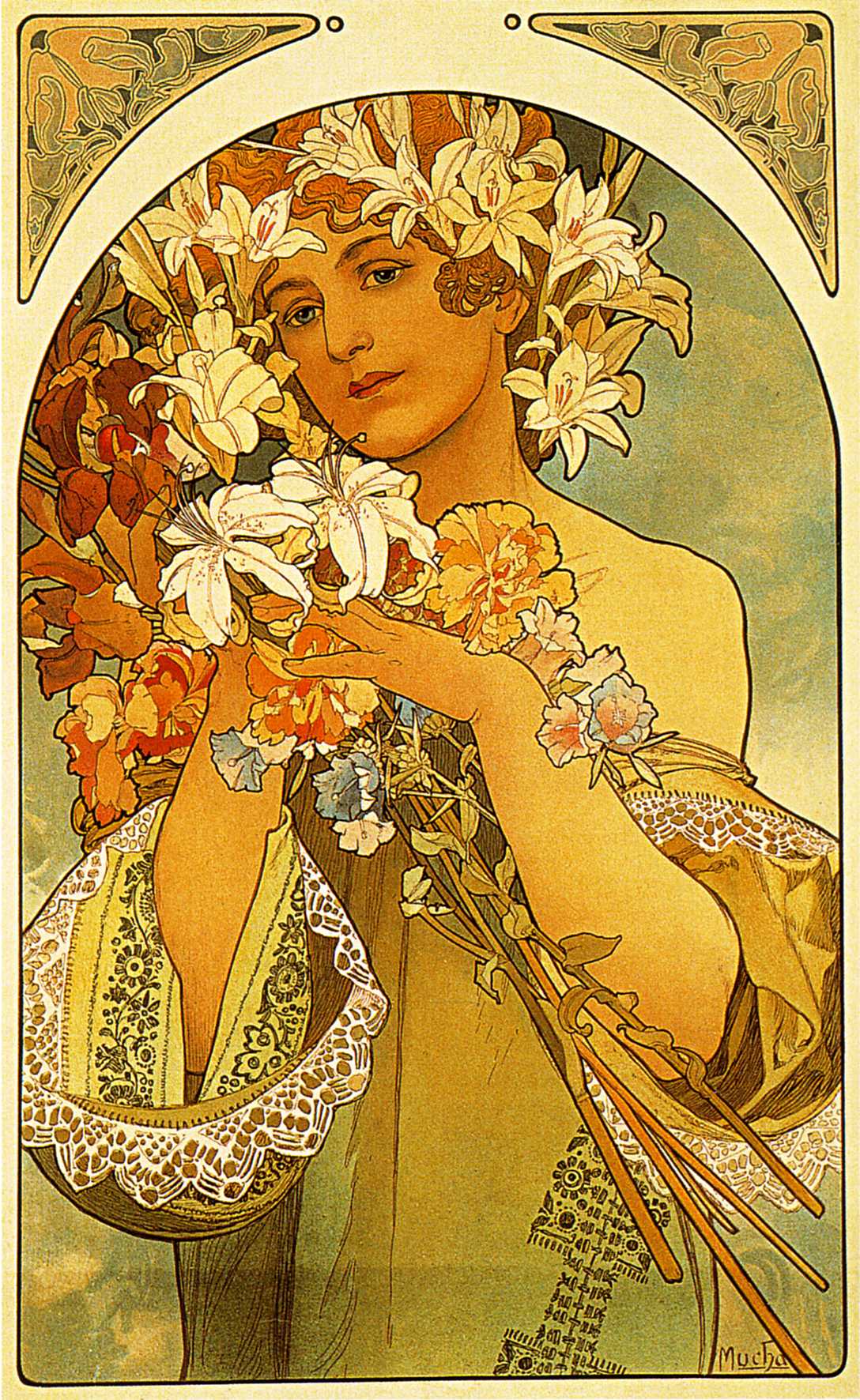
Alphonse Mucha


Alphonse Maria Mucha was born in the town of IvanĨiceMoravia. Alphonse Mucha is known for singing, which apparently helped him through school, but drawing was his main hobby from his childhood. 
he started his career by decorating mostly painting theatrical scenery. 


http://en.wikipeonse_Muchadia.org/wiki/Alph


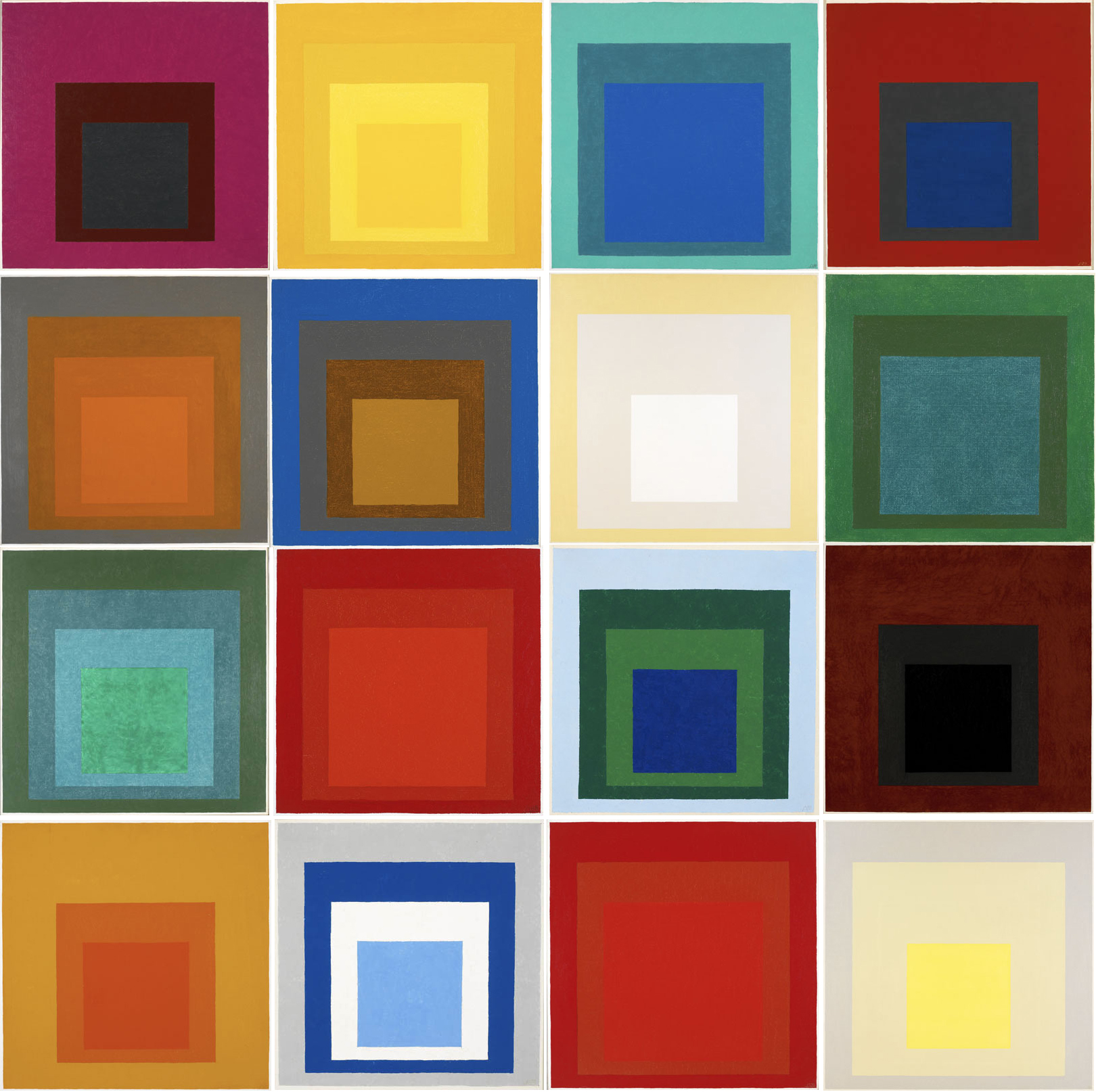
Joseph Albers abstract work. looks at colour theory, illusions and shape.


Accomplished as a designerphotographertypographerprintmaker, and poet, Albers is best remembered for his work as an abstract painter and theorist. He favoured a very disciplined approach to composition. Most famous of all are the hundreds of paintings and prints that make up the series, Homage to the Square. In this rigorous series, begun in 1949, Albers explored chromatic interactions with nested squares. Usually painting on Masonite, he used a palette knife with oil colours and often recorded the colours he used on the back of his works. Each painting consists of either three or four squares of solid planes of colour nested within one another, in one of four different arrangements and in square formats ranging from 406×406 mm to 1.22×1.22 m.


Kazimir Malevich.


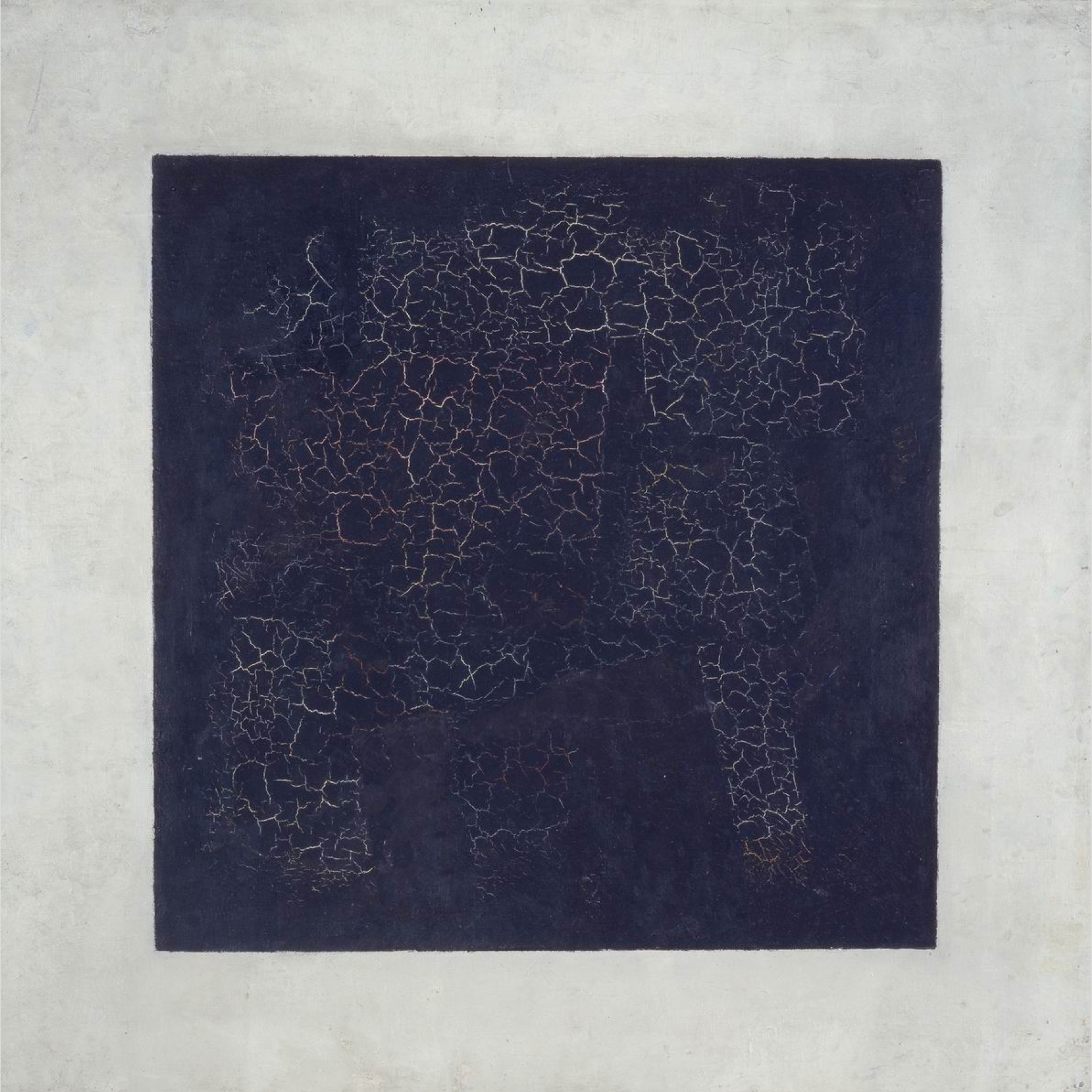
Kazimir Malevich used supremitism he created a series of work of black and white squares.


Malevich exhibited his first Black Square, now at the Tretyakov Gallery in Moscow, at the Last Futurist Exhibition 0,10 in Petrograd in 1915. A black square placed against the sun appeared for the first time in the 1913 scenery designs for the Futurist opera Victory over the Sun. The second Black Square was painted around 1923. Some believe that the third Black Square (also at the Tretyakov Gallery) was painted in 1929 for Malevich's solo exhibition, because of the poor condition of the 1915 square


In my opinion the work of Kazimir Malevich looks quite old fashioned because as it is cracked reminds me of architectural ruins. In contrast the work of Joseph Albers appears 

more modern and could be part of grafic design work or interior design today.


My work links to the work of Malevich and Albers in my choice of colour and composition. I have used different tone of blue in a form of a cross because i wanted to combine more squares together into a new structure. I chose the colour blue from
Albers work as a reference. Although i like his visual style i think the work was too simple and wanted to use the shape of he cross as guide to create a design that featured more colours.


the way in which I related my own work to Malevich was through using his black and white pallet and playing with borders. I decided to reverse his usual choice of black on white to experiment with white on black, the reason I decided to do this was to determine if this would work visually. I think that the outcome has characteristics of an illusion, certain squares appear closer than others.


work in progress


Wednesday, 3 June 2015

                                                        Printmaking Research


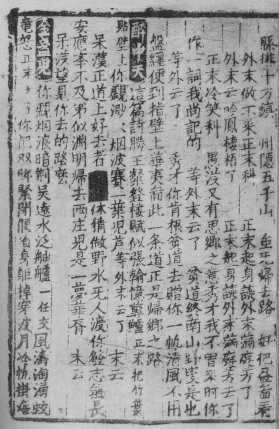
The Chinese invention of Woodblock printing, at some point before the first dated book in 868 (the Diamond Sutra), produced the world's first print culture. "It was the Chinese who really discovered the means of communication that was to dominate until our age." Woodblock printing was better suited to Chinese characters than movable type, which the Chinese also invented, but which did not replace woodblock printing. Western printing presses, although introduced in the 16th century, were not widely used in China until the 19th century. China, along with Korea, was one of the last countries to adopt them.


Wooden movable type printing – china

Although China developed at the first wooden movable type around 1040 AD, it was abandoned in favour of clay movable types. However, by the 1300s, a Chinese county office made 100,000 wooden movable types and printed 43 volume books. The world's earliest printer printed fragments to survive are also from China and are silk printed with flowers in three colours from the Han Dynasty (before AD 220). 


Techniques 


Traditionally, there have been two main printing techniques in Asia: woodblock printing and moveable type printing. In the woodblock techniques, ink is applied to letters carved upon a wooden board, which is then pressed onto paper. With moveable type, the board is assembled using different types, according to the page being printed. 


Digital Printing


Digital printing is relatively modern, it was founded in the 1970's. The first digital printing presses came onto the market in the early 1990's.

Digital printing assembles each image from a complex set of numbers and mathematical formulas. These images are captured from a matrix of dots, called pixels, and this process is called digitising. The digitised images are then used to control the deposition of ink, toner or exposure to electromagnetic energy to reproduce the data.
Digital printing uses a colour management system, which keeps images looking the same despite where they are printed.
In 1993 the world's first digital colour printing press was launched called Indigo. Overnight it triggered a transformation in the printing world - customers were able to choose short-run, personalised, high quality print straight from desktop.

Chinese Digital Printing

In modern times the Chinese printing culture uses machines instead of hand processes, these can be seen around the city on Billboards and advertising posters. 


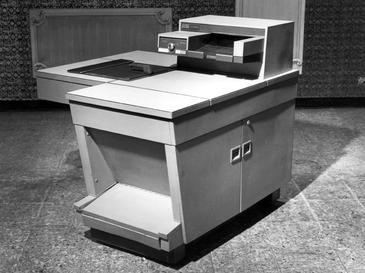
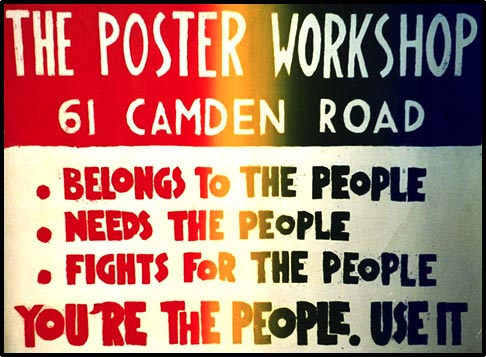
In other city's across the world digitally printed advertisements can also be seen, for example London's West End presents many theatre posters. London has its own history of printmaking. Between the late 1960's and 1970's numerous alternative print shops were set up across the UK, with the founding objective of producing, providing or facilitating the cheap and safe printing of radical materials. Here, printmaking and promotion was used to give people a political voice not a commercial one.


The London-based Poster Workshop (1968-1971), which recently uploaded its archive to the web, provides a snapshot of some radical concerns of the time e.g the political situations.


Thursday, 27 November 2014


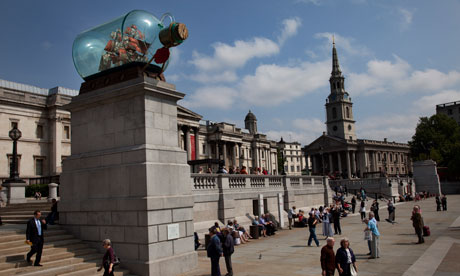
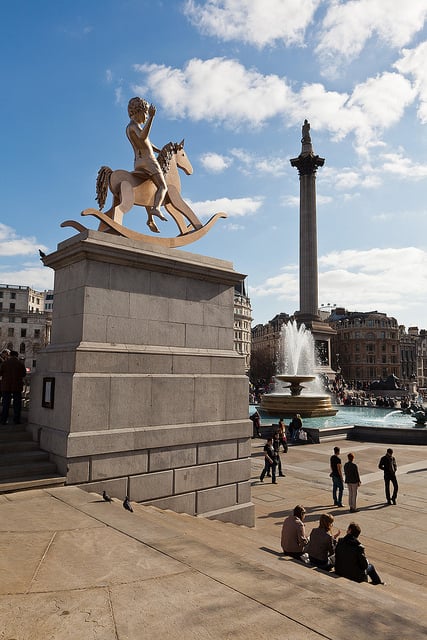
The Fourth Plinth is a plinth in Trafalgar Square in central London. It was originally intended to hold an equestrian statue of William IV, but remained bare due to insufficient funds. For over 150 years the fate of the plinth was debated; in 1999, a sequence of three contemporary artworks to be displayed on the plinth were announced. The success of this initiative led to a commission being formed to decide on a use for the plinth. Eventually that commission unanimously decided to continue using it for the temporary display of artworks.


There is a plinth at each of the four corners of the square. The two southern plinths carry sculptures of Henry Havelock andCharles James Napier. The northern plinths are larger than those as they were designed to have equestrian statues, and indeed the northeastern plinth has one of George IV. The fourth plinth on the northwest corner, designed by Sir Charles Barry and built in 1841, was intended to hold an equestrian statue of William IV, but remained empty due to insufficient funds.